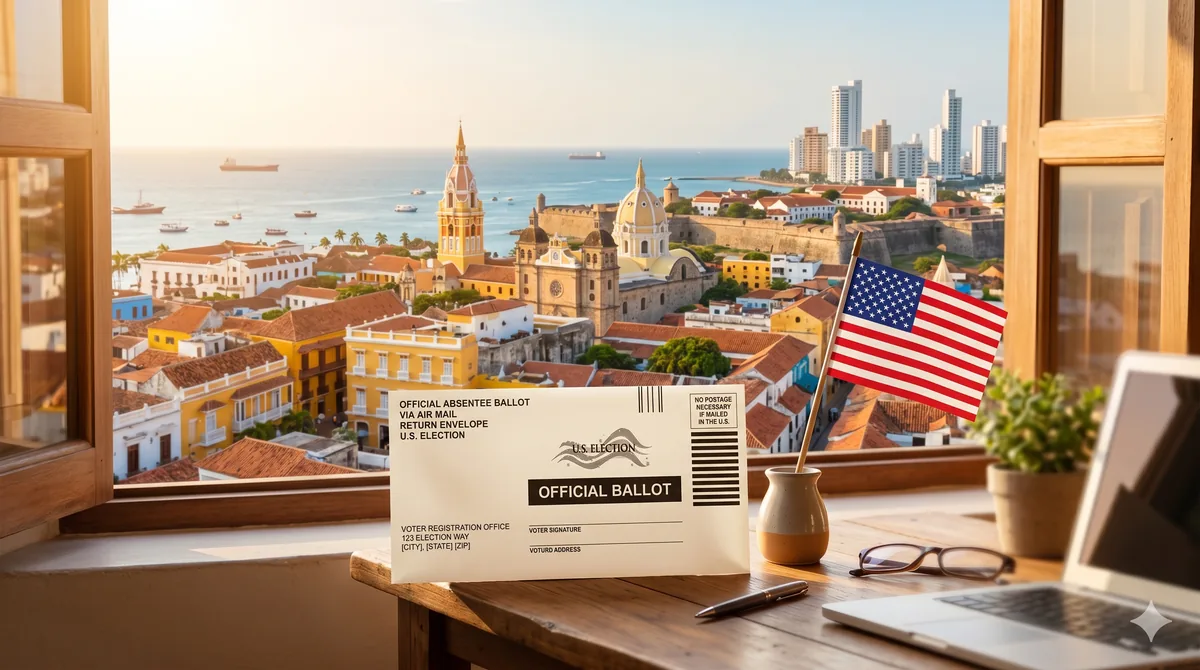
If you are a US citizen living in or visiting Medellín, you can still vote in the November 2026 midterms, and the whole process runs through one free, official website. This is a plain, nonpartisan walkthrough: who is eligible, the single form that starts everything, how to get your ballot, and the realistic ways to send it back from Colombia, including the US Embassy in Bogotá.
Specific question while you read? Ask Catalina, the Medellín Guide concierge.Chat with Catalina ›
This is general civic information, not legal advice, and it is nonpartisan. It explains the mechanics of voting from abroad, not who to vote for. The details that actually bite (registration cut-offs, whether you can return your ballot by email, the ballot-receipt deadline) are set by your state, not by the federal government. Confirm yours at FVAP.gov before you rely on any date here.
Start here: one website does most of the work
US citizens keep the right to vote in federal elections no matter where they live, including from Medellín. The whole process runs through one free, official, nonpartisan site: the Federal Voting Assistance Program at FVAP.gov, run by the US Department of Defense. It walks you through your specific state's rules, fills in the forms, and tells you how to send everything back. You do not pay anyone, and you do not need a US address or a US phone number to do it.
Two things to fix in your mind up front. First, you vote based on the last place you lived in the United States, not where you live now. Second, the single most useful action you can take today is to send one form, the Federal Post Card Application. Everything else follows from it.
What is on the ballot in 2026
The next US general election is the midterm on Tuesday, November 3, 2026. There is no presidential race this cycle, but the stakes are still real: all 435 seats in the House of Representatives, about a third of the Senate, dozens of governorships, and a long list of state and local offices and ballot measures are up for election. Whether you get to vote on the state and local parts depends on your voter status, which the next section explains.
Are you eligible? (Almost certainly yes)
You can vote from abroad if you are a US citizen, will be at least 18 by Election Day, and are not otherwise disqualified under your state's rules. Your right to vote from overseas comes from a federal law, the Uniformed and Overseas Citizens Absentee Voting Act (UOCAVA). For civilians it covers two groups:
US citizens living outside the United States, whether your stay in Colombia is permanent, open-ended, or you simply do not know how long you will be here.
US citizens temporarily abroad who intend to return, for example on a long trip, a work assignment, or an extended visit.
There is a useful difference between the two. If you are temporarily abroad, you generally receive a full ballot and can vote in federal, state, and local races. If you are an indefinite or permanent overseas resident, some states give you a federal-only ballot (President and Congress). Either way, you can vote for the offices that matter most.
Your voting address is your last US address. The state and county where you last lived in the US is where you are registered and where you send everything, even if you sold the house, even if you have no ties there anymore. You are not voting in Colombia's elections or registering at the embassy; you are an absentee voter in your old US precinct. A handful of states even let US citizens who have never lived in the US vote using a parent's last US address, so adult children of Americans born abroad should check too.
Step 1: Send your Federal Post Card Application (FPCA)
The FPCA is the master form. It does two jobs at once: it registers you to vote (or updates your registration) and it requests your absentee ballot. Submitting one good FPCA puts you on the list to receive ballots for every federal election in that calendar year.
How to do it:
Go to FVAP.gov and open the online assistant for overseas citizens. Enter your last US address and it loads your state's exact form and rules.
Fill it in and choose how you want to receive your blank ballot: email, fax, or postal mail, wherever your state allows it. Pick email if it is offered. It is faster and skips Colombian postal delays.
Print it, sign it (most states still require a handwritten signature), and send it to your local election office. Most states accept the completed FPCA by email or fax; some still require the paper original by mail.
Do it again every January. Your FPCA only covers the current calendar year. Experienced overseas voters re-send a fresh FPCA each January so they never miss a ballot. If you registered for a previous election, do not assume you are still on the list for 2026.
On timing: send your FPCA as early as you can in 2026. Registration cut-offs vary by state (some close roughly 30 days before the election, others are more generous), so a safe rule of thumb is to have your FPCA in by the end of September 2026. Earlier is always better, because it leaves room to fix any problem before ballots go out.
If you have not voted in years: some states automatically remove inactive voters from their rolls. The FPCA re-registers you each time you submit it, so treat it as a fresh start. If you are not sure whether your registration is current, FVAP's website will route you to your state's voter registration lookup. Finding out in September that you were purged is stressful; finding out in January is not.
Step 2: Receive your ballot
By federal law (the MOVE Act), states must send absentee ballots to overseas voters at least 45 days before a federal election. For November 3, 2026, that means your blank ballot should be sent by about September 19, 2026.
If you chose electronic delivery on your FPCA, your blank ballot arrives by email or through your state's online portal around that date. If you chose postal delivery, add two to four weeks of international mail time on top.
If it is past early October and nothing has arrived, do not wait. Contact your local election office (FVAP lists the contact for every county) and get ready to use the backup ballot described below.
Step 3: Vote it and send it back
This is the step where living in Colombia actually changes things, because the voted ballot has to get back to your county on time. You usually have three or four options, in rough order of speed:
Return it electronically, if your state allows it. Many states let overseas voters send the voted ballot back by email, fax, or a secure portal. This is by far the fastest route from Colombia and avoids the mail entirely. FVAP and your state portal will tell you whether you qualify and how.
Use the US Embassy in Bogotá's diplomatic pouch. Free, but slow. See the next section.
Use a courier (DHL, FedEx, UPS). Reliable and trackable, but you pay Colombian courier rates, which are not cheap, and you need a street-style delivery address, not a PO box.
Use Colombian post (4-72 / Servientrega). Workable but the slowest and least predictable. Only sensible if you started weeks early.
The deadline that counts is your state's ballot-return deadline, and it is stricter than the FPCA deadline. Many states must receive your voted ballot by the close of polls on Election Day (November 3, 2026). Some accept ballots postmarked by Election Day if they arrive within a few days. "Postmarked" means nothing if you return electronically or by courier, so check exactly what your state requires and work backward from it.
Returning your ballot through the US Embassy in Bogotá
If your state requires a paper ballot back and you would rather not pay a courier, the US Embassy in Bogotá will put your ballot into the diplomatic pouch to the United States for free.
Where. The embassy is at Carrera 45 No. 24B-27, Bogotá, D.C. Ballots are dropped at Gate 2 during business hours, Monday to Friday.
Postage. The pouch carries your envelope to a US sorting facility, but from there it travels as ordinary US mail. So the envelope must carry US domestic postage or be one of FVAP's postage-paid return envelopes (free to download and print from FVAP.gov). A Colombian stamp will not work for the US leg.
Time. Allow up to about four weeks for a pouch item to reach its US destination. That makes the pouch a plan you start in early October, not a last-minute fix.
Questions. The embassy has a Voting Assistance Officer. Email VoteBogota@state.gov for help with registration, your FPCA, or current pouch drop-off hours and procedures.
If you are not in Bogotá, factor in getting the envelope to the embassy in the first place. That is one more reason electronic return (where allowed) or a courier is often the better call from Medellín.
From Medellín: the embassy is roughly a 40 to 45 minute flight or a 7 to 8 hour bus from El Centro. Emailing VoteBogota@state.gov before making the trip is strongly recommended. Confirm the current drop-off window, whether a previous appointment is needed, and whether FVAP's postage-paid envelope is accepted for your state. The embassy's voting assistance team handles this regularly and is easy to reach by email.
If your ballot never arrives: the Federal Write-In Absentee Ballot (FWAB)
There is a federal safety net. If you requested your ballot on time but it has not shown up, you can vote using the Federal Write-In Absentee Ballot (FWAB), a backup ballot you fill in yourself with the candidates or parties you want. You can generate it through FVAP.gov and return it the same ways as a regular ballot.
Use it as a backup, not a first choice: send your FPCA and try for the real ballot first. If your official ballot arrives later, fill it out and send that too. Election offices count the official ballot and discard the FWAB if both come in, so you will not be voting twice.
The dates that matter for November 3, 2026
Step
Target date
Notes
Send your FPCA (register and request ballot)
As early as possible; aim for end of September 2026
Exact registration cut-off is set by your state
States send blank ballots
By about September 19, 2026
45 days before the election (federal MOVE Act rule)
Return your voted ballot
Varies by state; many require receipt by November 3, 2026
Some accept postmarked-by-Election-Day; verify yours
Election Day
Tuesday, November 3, 2026
The US midterm elections
Treat every "by Election Day" deadline as a receipt deadline unless your state explicitly says postmark, and from Colombia give yourself a generous head start.
If you are just visiting Colombia
Short-term visitors are covered too. If you are a US citizen traveling in Colombia around the election and your ballot is back home, you have two clean options: vote before you leave (early or in-person absentee if your trip allows), or treat yourself as temporarily abroad and run the same FPCA process above so your ballot reaches you here. Temporarily-abroad voters get the full ballot, so you do not lose your state and local races. The only real enemy is time, so start the FPCA the moment you know you will be away.
Common mistakes
Assuming you registered once and are done. The FPCA covers one calendar year. Re-send it in January 2026.
Choosing postal delivery when email was available. From Colombia, electronic delivery of the blank ballot saves you weeks.
Starting in late October. The embassy pouch alone can take four weeks. Build the whole plan around your state's return deadline and work backward.
Putting a Colombian stamp on a pouch envelope. The US leg needs US postage or an FVAP postage-paid envelope.
Not checking whether your state allows electronic return. Many do, and it is the single biggest time-saver available to you.
Confusing the two deadlines. The FPCA deadline is not the ballot-return deadline. The second one is what disqualifies a late vote.
FAQ
Do I need to vote at the US Embassy in Bogotá?
No. You do not register or vote at the embassy. You register with, and send your ballot to, your last US county. The embassy only answers questions and offers the free diplomatic-pouch mail option.
I have not lived in the US for years and gave up my old address. Can I still vote?
Yes. Your "voting address" is the last place you lived in the US, even if you have no ties there now. It decides your state and county; it does not have to be a current address.
Is there a fee?
No. FVAP, the FPCA, the FWAB, and the embassy pouch are all free. Anyone charging you to register to vote from abroad is not the official channel.
Can I return my ballot by email?
In many states, yes, overseas voters can return the voted ballot by email, fax, or a secure portal. Some states still require paper. Check your state on FVAP.gov; if electronic return is allowed, use it.
What if my ballot does not arrive in time?
Use the Federal Write-In Absentee Ballot (FWAB) from FVAP.gov as a backup. If your official ballot arrives later, fill it out and send it too; only one will be counted.
Does voting from abroad affect my US taxes or my state residency?
Voting in federal elections from overseas does not, by itself, create state tax liability. State rules differ, and this is a question for a cross-border accountant, not a voting guide.
My elderly parent is a US citizen here and struggles with the forms. Can I help?
Yes. You can sit with them and walk through the FVAP assistant; they sign their own form. The embassy's Voting Assistance Officer (VoteBogota@state.gov) can also help.
Catalina is our concierge. Ask her about visas, neighborhoods, healthcare, prices, anything Medellín. She answers in chat or WhatsApp, English or Spanish, free.
¿Una pregunta específica mientras lees? Pregúntale a Catalina, la asistente de la Guía de Medellín.Chatea con Catalina ›
Esta es información cívica general, no asesoría legal, y es imparcial. Explica la mecánica de votar desde el extranjero, no por quién votar. Los detalles que realmente importan (plazos de registro, si puedes devolver tu boleta por correo electrónico, la fecha límite de recepción de boletas) los establece tu estado, no el gobierno federal. Confirma los tuyos en FVAP.gov antes de confiar en cualquier fecha aquí.
Comienza aquí: un sitio web hace la mayor parte del trabajo
Los ciudadanos de EE.UU. conservan el derecho a votar en las elecciones federales sin importar dónde vivan, incluyendo desde Medellín. Todo el proceso se realiza a través de un sitio oficial gratuito e imparcial: el Programa Federal de Asistencia para Votantes en FVAP.gov, administrado por el Departamento de Defensa de EE.UU. Te guía a través de las reglas específicas de tu estado, completa los formularios y te dice cómo enviar todo. No pagas a nadie, y no necesitas una dirección de EE.UU. ni un número de teléfono de EE.UU. para hacerlo.
Dos cosas para tener en mente desde el principio. Primero, votas basándote en el último lugar donde viviste en Estados Unidos, no donde vives ahora. Segundo, la acción más útil que puedes tomar hoy es enviar un formulario, la Solicitud de Tarjeta Postal Federal. Todo lo demás fluye de eso.
Qué está en la boleta en 2026
La próxima elección general de EE.UU. es la de mitad de período el martes, 3 de noviembre de 2026. No hay carrera presidencial este ciclo, pero los riesgos siguen siendo reales: los 435 escaños de la Cámara de Representantes, aproximadamente un tercio del Senado, docenas de gobernaciones y una larga lista de cargos locales y estatales y medidas de votación están en elecciones. Si puedes votar sobre las partes estatales y locales depende de tu estatus de votante, que la próxima sección explica.
¿Eres elegible? (Casi seguro que sí)
Puedes votar desde el extranjero si eres ciudadano de EE.UU., tendrás al menos 18 años el día de las elecciones y no estás de otra manera descalificado según las reglas de tu estado. Tu derecho a votar desde el extranjero proviene de una ley federal, la Ley de Voto Ausente Uniforme y de Ciudadanos en el Extranjero (UOCAVA). Para civiles cubre dos grupos:
Ciudadanos de EE.UU. que viven fuera de Estados Unidos, ya sea que tu estancia en Colombia sea permanente, abierta o simplemente no sepas cuánto tiempo estarás aquí.
Ciudadanos de EE.UU. temporalmente en el extranjero que tienen la intención de regresar, por ejemplo en un viaje largo, una asignación de trabajo o una visita extendida.
Hay una diferencia útil entre los dos. Si estás temporalmente en el extranjero, generalmente recibes una boleta completa y puedes votar en las carreras federales, estatales y locales. Si eres un residente extranjero indefinido o permanente, algunos estados te dan una boleta solo federal (Presidente y Congreso). De cualquier forma, puedes votar por los cargos que más importan.
Tu dirección de votación es tu última dirección en EE.UU. El estado y condado donde último viviste en EE.UU. es donde estás registrado y donde envías todo, incluso si vendiste la casa, incluso si ya no tienes conexiones allá. No estás votando en las elecciones de Colombia ni registrándote en la embajada; eres votante ausente en tu viejo precinto de EE.UU. Algunos estados incluso permiten que ciudadanos de EE.UU. que nunca han vivido en EE.UU. voten usando la última dirección de EE.UU. de un padre, así que los hijos adultos de estadounidenses nacidos en el extranjero también deben verificar.
Paso 1: Envía tu Solicitud de Tarjeta Postal Federal (FPCA)
La FPCA es el formulario maestro. Hace dos trabajos a la vez: te registra para votar (o actualiza tu registro) y solicita tu boleta ausente. Enviar una buena FPCA te pone en la lista para recibir boletas para cada elección federal en ese año calendario.
Cómo hacerlo:
Ve a FVAP.gov y abre el asistente en línea para ciudadanos en el extranjero. Ingresa tu última dirección de EE.UU. y cargará el formulario y las reglas exactas de tu estado.
Complétalo y elige cómo quieres recibir tu boleta en blanco: correo electrónico, fax o correo postal, donde tu estado lo permita. Elige correo electrónico si se ofrece. Es más rápido y evita los retrasos del correo colombiano.
Imprimelo, fírmalo (la mayoría de los estados aún requieren una firma manuscrita) y envíalo a tu oficina electoral local. La mayoría de los estados aceptan el FPCA completado por correo electrónico o fax; algunos aún requieren el original de papel por correo.
Hazlo de nuevo cada enero. Tu FPCA solo cubre el año calendario actual. Los votantes experimentados en el extranjero reenían un FPCA nuevo cada enero para no perder nunca una boleta. Si te registraste para una elección anterior, no asugas que aún estés en la lista para 2026.
Sobre el tiempo: envía tu FPCA tan pronto como puedas en 2026. Los plazos de registro varían por estado (algunos cierran aproximadamente 30 días antes de la elección, otros son más generosos), así que una regla segura es tener tu FPCA lista a finales de septiembre de 2026. Más temprano siempre es mejor, porque deja espacio para arreglar cualquier problema antes de que las boletas salgan.
Si no has votado en años: algunos estados eliminan automáticamente a los votantes inactivos de sus registros. El FPCA te registra nuevamente cada vez que lo envías, así que trátalo como un nuevo comienzo. Si no estás seguro de que tu registro esté actualizado, el sitio web de FVAP te dirigirá a la búsqueda de registro de votantes de tu estado. Descubrir en septiembre que fuiste eliminado es estresante; descubrirlo en enero no lo es.
Paso 2: Recibe tu boleta
Por ley federal (la Ley MOVE), los estados deben enviar boletas ausentes a votantes en el extranjero al menos 45 días antes de una elección federal. Para el 3 de noviembre de 2026, eso significa que tu boleta en blanco debe ser enviada alrededor del 19 de septiembre de 2026.
Si elegiste entrega electrónica en tu FPCA, tu boleta en blanco llega por correo electrónico o a través del portal en línea de tu estado alrededor de esa fecha. Si elegiste entrega postal, suma de dos a cuatro semanas de tiempo de correo internacional.
Si es pasado principios de octubre y nada ha llegado, no esperes. Contacta a tu oficina electoral local (FVAP lista el contacto de cada condado) y prepárate para usar la boleta de respaldo descrita a continuación.
Paso 3: Vota y devuélvela
Este es el paso donde vivir en Colombia realmente cambia las cosas, porque la boleta votada tiene que regresar a tu condado a tiempo. Normalmente tienes tres o cuatro opciones, en orden aproximado de velocidad:
Devuélvela electrónicamente, si tu estado lo permite. Muchos estados permiten que los votantes en el extranjero envíen la boleta votada por correo electrónico, fax o un portal seguro. Esta es la ruta más rápida desde Colombia y evita el correo por completo. FVAP y tu portal estatal te dirán si calificas y cómo.
Usa la valija diplomática de la Embajada de EE.UU. en Bogotá. Gratis, pero lento. Ver la siguiente sección.
Usa un servicio de mensajería (DHL, FedEx, UPS). Confiable y rastreable, pero pagas tarifas de mensajería colombiana, que no son baratas, y necesitas una dirección de calle, no una casilla postal.
Usa el correo colombiano (4-72 / Servientrega). Funciona pero es el más lento e impredecible. Solo tiene sentido si comenzaste semanas antes.
La fecha límite que cuenta es la fecha límite de devolución de boleta de tu estado, y es más estricta que la del FPCA. Muchos estados deben recibir tu boleta votada antes del cierre de las urnas el día de las elecciones (3 de noviembre de 2026). Algunos aceptan boletas fechadas el día de las elecciones si llegan dentro de unos días. "Fechada" no significa nada si devuelves electrónicamente o por mensajería, así que verifica exactamente qué requiere tu estado y trabaja hacia atrás desde eso.
Devolver tu boleta a través de la Embajada de EE.UU. en Bogotá
Si tu estado requiere una boleta de papel de vuelta y prefieres no pagar un servicio de mensajería, la Embajada de EE.UU. en Bogotá pondrá tu boleta en la valija diplomática a Estados Unidos de forma gratuita.
Dónde. La embajada está en Carrera 45 No. 24B-27, Bogotá, D.C. Las boletas se entregan en la Puerta 2 durante el horario de atención, de lunes a viernes.
Franqueo. La valija lleva tu sobre a una instalación de clasificación de EE.UU., pero desde allá viaja como correo ordinario de EE.UU. Así que el sobre debe llevar franqueo doméstico de EE.UU. o ser uno de los sobres de devolución con franqueo pagado de FVAP (gratis para descargar e imprimir desde FVAP.gov). Un sello colombiano no funcionará para la parte de EE.UU.
Tiempo. Permite aproximadamente cuatro semanas para que un artículo de valija llegue a su destino en EE.UU. Eso hace de la valija un plan que comienzas a principios de octubre, no una solución de último minuto.
Preguntas. La embajada tiene un Oficial de Asistencia para Votantes. Envía un correo electrónico a VoteBogota@state.gov para obtener ayuda con el registro, tu FPCA u horarios y procedimientos actuales de entrega de valija.
Si no estás en Bogotá, factoriza llegar al sobre a la embajada en primer lugar. Esa es una razón más por la que la devolución electrónica (donde se permite) o un servicio de mensajería es a menudo la mejor opción desde Medellín.
Desde Medellín: la embajada está aproximadamente a 40 a 45 minutos en vuelo o a 7 u 8 horas en autobús desde El Centro. Se recomienda enfáticamente enviar un correo electrónico a VoteBogota@state.gov antes de hacer el viaje. Confirma la ventana de entrega actual, si se necesita una cita previa, y si el sobre con franqueo pagado de FVAP se acepta para tu estado. El equipo de asistencia para votantes de la embajada maneja esto regularmente y es fácil de contactar por correo electrónico.
Si tu boleta nunca llega: la Boleta Federal de Voto Ausente por Escrito (FWAB)
Hay una red de seguridad federal. Si solicitaste tu boleta a tiempo pero no ha llegado, puedes votar usando la Boleta Federal de Voto Ausente por Escrito (FWAB), una boleta de respaldo que completas tú mismo con los candidatos o partidos que quieres. Puedes generarla a través de FVAP.gov y devolverla de la misma forma que una boleta normal.
Úsala como respaldo, no como primera opción: envía tu FPCA e intenta obtener la boleta real primero. Si tu boleta oficial llega después, complétala y envíala también. Las oficinas electorales cuentan la boleta oficial y descartan la FWAB si ambas llegan, así que no estarás votando dos veces.
Las fechas que importan para el 3 de noviembre de 2026
Paso
Fecha objetivo
Notas
Envía tu FPCA (registra y solicita boleta)
Tan pronto como sea posible; apunta a finales de septiembre de 2026
La fecha límite exacta de registro la establece tu estado
Los estados envían boletas en blanco
Alrededor del 19 de septiembre de 2026
45 días antes de la elección (regla federal de la Ley MOVE)
Devuelve tu boleta votada
Varía por estado; muchos requieren recepción antes del 3 de noviembre de 2026
Algunos aceptan fechada el día de las elecciones; verifica el tuyo
Día de las elecciones
Martes, 3 de noviembre de 2026
Las elecciones de mitad de período de EE.UU.
Trata cada fecha límite de "antes del día de las elecciones" como una fecha límite de recepción a menos que tu estado diga explícitamente fecha, y desde Colombia date un comienzo generoso.
Si solo estás visitando Colombia
Los visitantes a corto plazo también están cubiertos. Si eres ciudadano de EE.UU. viajando en Colombia alrededor de la elección y tu boleta está en casa, tienes dos opciones claras: vota antes de irte (votación anticipada o ausente en persona si tu viaje lo permite), o trátate a ti mismo como temporalmente en el extranjero y ejecuta el mismo proceso FPCA anterior para que tu boleta te llegue aquí. Los votantes temporalmente en el extranjero obtienen la boleta completa, así que no pierdes tus carreras estatales y locales. El único enemigo real es el tiempo, así que comienza el FPCA en el momento en que sepas que estarás fuera.
Errores comunes
Asumir que te registraste una vez y ya está. El FPCA cubre un año calendario. Reenvialo en enero de 2026.
Elegir entrega postal cuando el correo electrónico estaba disponible. Desde Colombia, la entrega electrónica de la boleta en blanco te ahorra semanas.
Comenzar a finales de octubre. La valija de la embajada sola puede tomar cuatro semanas. Construye todo el plan alrededor de la fecha límite de devolución de tu estado y trabaja hacia atrás.
Poner un sello colombiano en un sobre de valija. La parte de EE.UU. necesita franqueo de EE.UU. o un sobre con franqueo pagado de FVAP.
No verificar si tu estado permite devolución electrónica. Muchos lo permiten, y es el mayor ahorro de tiempo disponible para ti.
Confundir los dos plazos. La fecha límite del FPCA no es la fecha límite de devolución de boleta. La segunda es la que descalifica un voto tardío.
Preguntas frecuentes
¿Necesito votar en la Embajada de EE.UU. en Bogotá?
No. No te registras ni votas en la embajada. Te registras con, y envías tu boleta a, tu último condado de EE.UU. La embajada solo responde preguntas y ofrece la opción de valija diplomática de correo gratuita.
No he vivido en EE.UU. durante años y abandoné mi dirección anterior. ¿Puedo aún votar?
Sí. Tu "dirección de votación" es el último lugar donde viviste en EE.UU., incluso si no tienes conexiones allá ahora. Decide tu estado y condado; no tiene que ser una dirección actual.
¿Hay una tarifa?
No. FVAP, el FPCA, el FWAB y la valija de la embajada son todos gratuitos. Cualquiera que te cobre por registrarte para votar desde el extranjero no es el canal oficial.
¿Puedo devolver mi boleta por correo electrónico?
En muchos estados, sí, los votantes en el extranjero pueden devolver la boleta votada por correo electrónico, fax o un portal seguro. Algunos estados aún requieren papel. Verifica tu estado en FVAP.gov; si se permite la devolución electrónica, úsala.
¿Qué pasa si mi boleta no llega a tiempo?
Usa la Boleta Federal de Voto Ausente por Escrito (FWAB) desde FVAP.gov como respaldo. Si tu boleta oficial llega después, complétala y envíala también; solo una será contada.
¿Votar desde el extranjero afecta mis impuestos de EE.UU. o mi residencia estatal?
Votar en elecciones federales desde el extranjero no crea, por sí solo, responsabilidad fiscal estatal. Las reglas estatales varían, y esta es una pregunta para un contador transfronterizo, no para una guía de votación.
Mi padre anciano es ciudadano de EE.UU. aquí y lucha con los formularios. ¿Puedo ayudar?
Sí. Puedes sentarte con él y caminar a través del asistente de FVAP; él firma su propio formulario. El Oficial de Asistencia para Votantes de la embajada (VoteBogota@state.gov) también puede ayudar.
Catalina es nuestra asistente. Pregúntale sobre visas, barrios, salud, precios, cualquier cosa sobre Medellín. Responde en chat o WhatsApp, inglés o español, gratis.
If you are a US citizen here and the FVAP site or your state's portal is tripping you up, ask Catalina. She can point you to the right form, explain your state's return options, and remind you of the deadline.
Get Medellín in your inboxRecibe Medellín en tu correo
One short Saturday email. New guides, what's on this week, and the things worth knowing. No noise.Un correo corto cada sábado. Nuevas guías, qué hay esta semana, y lo que vale la pena saber. Sin ruido.