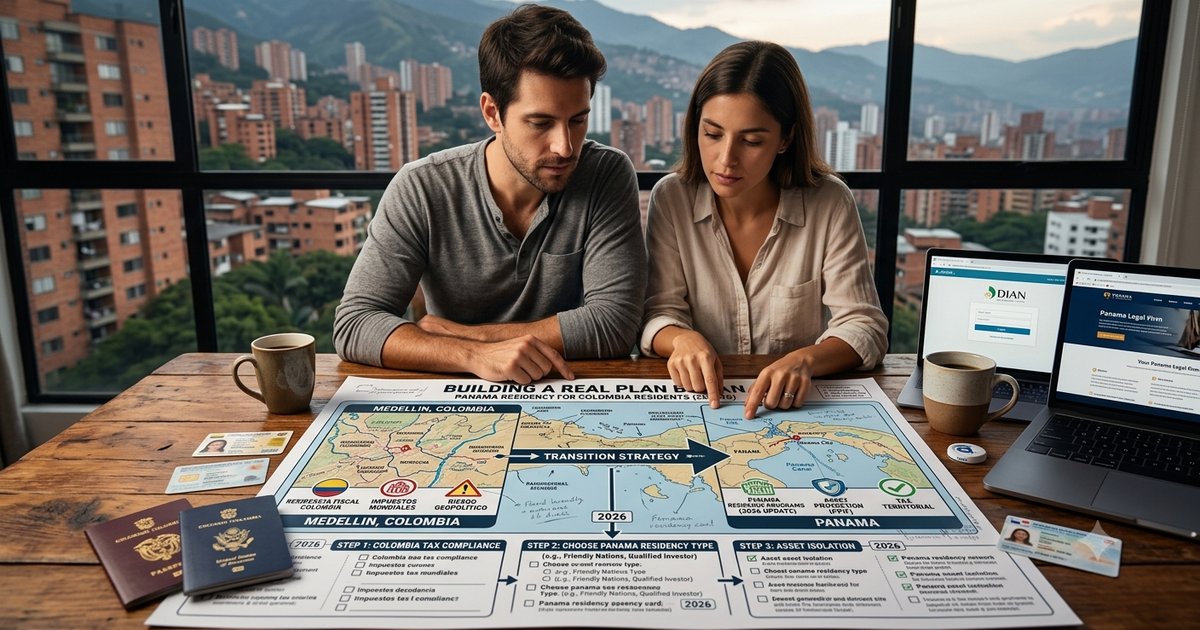
A Second Residency Is Your Plan B
A second residency isn't about leaving home, it's about creating options.
This practical guide explains Panama's most popular residency pathways, including Friendly Nations, Qualified Investor, Pensionado, and other available programs. You'll also learn how to manage residency requirements in two countries at once, when a Panama company or a Private Interest Foundation actually makes sense, avoid common mistakes, and understand the day-count rules that can affect your long-term plans.
Whether you're looking for greater mobility, asset protection, tax flexibility, or simply peace of mind, this guide provides a clear starting point.
You didn't move to Colombia because you wanted a more complicated life. You came for the freedom, Medellín's weather, weekends in Guatapé, the realization that your money buys a much better lifestyle here than it ever did back home. Maybe you simply wanted a life where work fits around living, not the other way around.
But after a year or two, many internationally mobile professionals start asking a different question: what if I want a real Plan B? Not because something has gone wrong. Because life changes. Governments change. Tax rules change. Immigration policies change. Businesses grow. Families grow. When you've spent years building your wealth, having everything tied to a single country starts to feel less like simplicity and more like unnecessary risk.
For many people living in Colombia, Panama becomes that second foundation. Not because they're trying to escape Colombia. Because they're trying to build more options.
What a second residency really gives you
There's a common misconception that a second residency is about avoiding taxes. For most successful international professionals, it isn't. It's about creating resilience.
Think of it this way. If Colombia became more difficult to live in tomorrow, where would you go? If your home country introduced rules that no longer fit your lifestyle, what would your next move be? If your bank suddenly questioned your international lifestyle, where else could you legitimately bank?
A second residency answers those questions before they become problems. It gives you another legal home, another banking jurisdiction, another place where you have the right to live, not just visit on a tourist stamp. That's why people earning good incomes and living internationally often think in terms of options, not escape plans.
Why Panama
For someone already living in Colombia, Panama is remarkably practical. Panama City is about a 90-minute flight from Medellín: close enough for a quick business trip, close enough to maintain relationships, close enough that building a genuine presence there doesn't require turning your life upside down. That's one reason Panama has become such a popular complement to life in Colombia.
The other reason is its legal and financial infrastructure. Panama offers internationally recognized corporate structures, a long-established banking sector, and a territorial tax system that generally taxes income earned inside Panama while treating many types of foreign-source income differently. For globally mobile professionals, those characteristics often make Panama an attractive second base.
Panama isn't one program
One of the biggest mistakes people make is talking about "the Panama visa." There isn't just one. Panama offers several residency pathways, each designed for different circumstances: some intended for investors, others for retirees, some for entrepreneurs establishing a Panamanian company, and others for professionals or people working remotely for overseas clients.
Which path makes sense depends entirely on your circumstances. Because eligibility requirements and investment thresholds change over time, we don't publish specific dollar amounts that may become outdated. Those details should always be confirmed with licensed Panamanian immigration counsel before making decisions.
Residency is only part of the picture
Many people arrive thinking they need a residency. What they often need is a strategy. Someone running an international consulting business, for example, may benefit from combining:
- Panamanian residency
- A Panama corporation
- Banking in Panama
- A Panama Private Interest Foundation for long-term asset protection and succession planning
Someone else may need only residency. Another family may need something much more comprehensive. The right structure depends less on the products themselves than on your goals.
Living between Colombia and Panama
One reason this combination works so well is geography. Many people continue enjoying life in Medellín while using Panama as their second legal and financial home. That doesn't mean ignoring Colombian tax rules. Quite the opposite.
Colombia determines tax residency primarily through the amount of time you spend in the country. Panama has its own residency requirements depending on the immigration program you choose. If your lifestyle spans both countries, keeping accurate records of your travel days isn't optional: it's part of good planning.
The people who avoid problems aren't the ones who memorize tax law. They're the ones who stay organized from day one.
The mistakes we see most often
Almost every expensive mistake starts with good intentions. Someone reads an outdated blog. A YouTube video simplifies a complex topic. A Facebook group confidently repeats advice that's no longer accurate. The most common mistakes include:
- Choosing a residency program based on outdated information
- Assuming a second residency automatically changes your tax residency
- Confusing residency with citizenship
- Waiting until tax season to figure out where you spent your time
- Trying to coordinate lawyers, accountants, banks, and government offices alone
International planning is rarely complicated because the rules are impossible. It's complicated because several different systems have to work together.
Build the structure before you need it
The best time to build a Plan B is before you need one. For many internationally mobile professionals, that means creating a structure that combines residency, corporate planning, banking, and long-term asset protection into one coordinated strategy. Whether that includes only Panamanian residency, or also a corporation and a Private Interest Foundation, depends entirely on your circumstances.
The objective is never simply to own a Panamanian company, a foundation, or a residency card. The objective is to create a life where your wealth, your business, and your family have options, wherever your next chapter takes you.
If you're not sure what that should look like, start with a confidential conversation with Catalina. Tell her about your situation, your goals, and the life you're building. She'll help you understand which options make sense before you commit to anything.
Related reading on this topic: The Worldwide Income Trap: Why DIY Tax Answers Fail Once You Live in Colombia, When a Remote Contractor Actually Needs a Panama Company, Asset Protection and Succession Planning with a Panama Foundation.
Still have questions?
Catalina is our concierge. Ask her about visas, neighborhoods, healthcare, prices, anything Medellín. She answers in chat or WhatsApp, English or Spanish, free.
Chat with Catalina ›